Tuesday, January 30, 2007

Ou Virak: certainly they are not the ones ordered the killing

Sunday, January 22, 2006

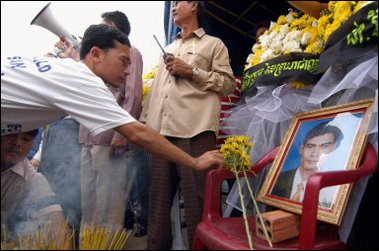
Slain Cambodian union leader remembered amid rights crackdown

A Cambodian man puts flowers in front of a portrait of late union president Chea Vichea to commemorate his assassination in Phnom Penh. Cambodian rights groups demanded a review of guilty verdicts against two men convicted of Chea Vichea - former head of the opposition-linked Free Trade Union of the Workers of the Kingdom of Cambodia - who was gunned down at a Phnom Penh food stall two years ago (AFP/Tang Chhin)

Time is GMT + 8 hours
Posted: 22-Jan-2006 14:54 hrs


Cambodian rights groups demanded a review of guilty verdicts against two men convicted of killing union president Chea Vichea, as more than 100 people marched to commemorate his assassination.
.
Chea Vichea, who was head of the opposition-linked Free Trade Union of the Workers of the Kingdom of Cambodia, was gunned down at a Phnom Penh food stall two years ago.
.
Two men, Born Samnang, 23, and Sok Sam Oeun, 36, were arrested just days after the daylight shooting and convicted of murder, but Cambodian and international activists insist the real killers remain at large.
.
"Certainly, they are not the ones who ordered the killing," said Ou Virak, general secretary of the Alliance for Freedom of Expression in Cambodia.
.
"We demand a proper review of this court judgment, and further investigations by Cambodian authorities until the real culprits are caught and punished."
.
The Phnom Penh Municipal Court dismissed the charges against the men in March 2004, but the decision was overruled, the judge transferred and the case sent to the Court of Appeal.
.
Sok Sam Oeun's father, Vuon Phon, said the trial should be reopened.
.
"I demand real justice ... the trial of my son was very unjust. It's not right," he said before the start of the march.
.
The local director of the UN's human rights agency, Margo Picken, said the murder trial failed to meet any judicial standards and "therefore we do not think that they would be proved guilty to the charge."
.
She also said a further investigation should be conducted into the handling of the trial, which was largely dismissed as a coverup for a political killing.
.
The popular 36-year-old leader, who founded the union along with opposition leader Sam Rainsy and several others, had organised many protests fighting for the rights of garment workers. These frequently led to clashes with police.
.
More than 100 people, including several prominent government critics recently released on bail from prison, marched from the union's offices to the spot where Chea Vichea was killed to place wreaths and make speeches in a low-key memorial.
.
The march came amid a broad clampdown on dissent that has seen nearly a dozen people arrested or facing punishment, mostly for defamation. It took place under a heavy police presence.
.
The defamation arrests have sparked international condemnation from rights groups and foreign governments accusing Prime Minister Hun Sen of using the courts to crush any opposition to his administration.
.
Five key critics were granted bail last week in an apparent climbdown by the government, but Hun Sen said Sunday that the defamation charges against them would stand.
.
"Right now they are culprits, so the government can guarantee them bail but the charges cannot be dropped," Hun Sen said.
.
"After the trial I will see if their attitude has changed. I still have the ability to ask for clemency," he said, adding that he was unlikely to do so if they remained unrepentant.
.
Organisers of the rally took the opportunity to urge more freedoms in Cambodia, leading chants of "Democracy forever, the government has to respect human rights".
.
"This is very symbolic. The strategy is not confrontation," said opposition party member Mu Sochua when asked about the low turnout.
.
"The strategy is holding on to democratic principles. It's a long way to go (to full democracy)." — AFP

Ou Virak: 'The regime is trying to find any reason to silence us'

Tuesday, January 17, 2006

'The regime is trying to find any reason to silence us'

An aggressive crackdown aimed at government critics threatens to derail Cambodia's frail democracy, GEOFFREY YORK writes

By GEOFFREY YORK
Monday, January 16, 2006

Globe and Mail, Canada

PHNOM PENH -- The handwritten slogan, scrawled in marker ink on an old banner, was so small and faded that few people noticed it.

But the scribbled comments, denouncing the Prime Minister as a traitor, were spotted by the ever-watchful eyes of the Cambodian government. Last month they became the pretext for its latest crackdown. Scores of police swooped down on human-rights offices in Phnom Penh and arrested three activists, accusing them of "defaming" the government.
They were among nearly a dozen activists, politicians and journalists who have been hit with criminal prosecutions in the past four months. A climate of fear has descended on this impoverished nation, forcing dozens of activists to flee. There are mounting anxieties about the possible death of Cambodia's fledgling democracy.
The crackdown has provoked dismay from the United Nations and the international community, which have pumped more than $7-billion (U.S.) in aid into Cambodia over the past 15 years.
Freedom of speech, one of the main achievements of the peace agreements of the early 1990s, is now under severe threat. Many observers believe that Cambodia is on the road to becoming a dictatorship again.
Even though the international community has considerable leverage over Cambodia -- providing annual aid of close to $500-million (U.S.), almost half of its entire budget -- it has failed to halt the drift toward authoritarianism.
The driving force behind this trend is Cambodia's shrewd and powerful ruler, Prime Minister Hun Sen, who has controlled politics with an autocratic grip for more than 20 years.
Nobody doubts that Mr. Sen authorized the crackdown that has been gaining momentum since 2003, when he banned all public demonstrations. Last year he forced the main opposition leader, Sam Rainsy, to flee into exile to avoid prison. The opposition leader was later convicted in absentia and sentenced to 18 months in jail.
Mr. Sen, a peasant's son and chess-playing ex-Marxist guerrilla, was supremely confident when he faced a group of journalists in Phnom Penh late last week. He dismissed the jailed activists as "a few individuals" who had "crossed the line" by "cursing" the government. He accused them of trying to overthrow the regime. "I am the victim," he insisted.
The embattled opposition sees it differently. Dozens of politicians and human-rights activists, fearing arrest, have gone into exile or slipped into hiding in the past several months.
"Almost every group that criticizes the government has at least one person in jail," said Ou Virak, spokesman for the Cambodian Centre for Human Rights, one of the leading human-rights groups in the country.
"The situation is going from bad to worse -- much, much worse. A lot of people are scared. Anyone can be thrown into jail. The regime is trying to find any reason to silence us. Cambodia is on the road to dictatorship. Hun Sen is a strongman and he's trying to consolidate his tight control of this country."
The two top leaders of the human-rights centre were arrested in the crackdown last month. Both remain in jail, accused of criminal defamation in connection with the faded slogan that was spotted on a banner at the centre's booth during the annual celebration of International Human Rights Day on Dec. 10.
The main slogan on the banner, which had been printed two years earlier, was: "Protect my vote, protect my life." Dozens of ordinary people had added their own handwritten comments on the banner in marker pen, and the denunciation of Mr. Sen was one of those comments, but nobody seemed to notice it until the police raids began.
The human-rights centre has organized a series of village meetings during the past two weeks, gathering 40,000 names on petitions to seek freedom for the jailed activists. One of the activists was released on bail last week. But at the village meetings, many people spoke of their fear of arrest. Many were obviously nervous, refusing to disclose their names and expressing concern that they could be arrested for attending the meetings.
"When they arrest democratic leaders, it puts fear into all of us," said Prak Senglong, a 25-year-old university student, who spoke at a village meeting in a farmer's field near the Mekong River. Dozens of his friends wanted to attend the meeting, he said, but were deterred by the danger of being arrested.

Ou Virak: there's a group of people who would love to see the end of CCHR

Friday, April 7, 2006

SRP Fax: Kem Sokha Plans 'People Power Party'

By Yun Samean
THE CAMBODIA DAILY

Sam Rainsy Party members faxed an anonymous statement to media outlets Thursday accusing Cambodian Center for Human Rights President Kem Sokha of masquerading as a human rights activist and planning to establish a "People Power Party."

The statement, faxed from the party's headquarters, claimed that Kem Sokha draws most of his support from the SRP and is using the structure in place at the CCHR and his growing network of contacts in France, the US and Australia to build the political party.

"The PPP will cooperate with former members of the Son Sann Party and the members of the Cambodian Center for Human Rights," the statement reads.

"Members of the SRP, Funcinpec and CPP are being courted by Kem Sokha," it added, before poking fun at Kem Sokha's overseas education.

"Kem Sokha was a former student from Czechoslovakia in producing canned fish," it stated.

SRP Acting Secretary General Meng Rita said the party had received the statement by email and mistakenly issued it to the media.

"My colleagues sent it to the media without my consent" he said.

SRP lawmaker Eng Chhay Eang said the statement had been received from a French e-mail address, adding that SRP members were banned from continuing to distribute it.

"We advised them already. We warned them," he said.

Kem Sokha was reportedly in the US on Thursday and could not be reached for comment.

CCHR spokesman Ou Virak reiterated previous statements that Kem Sokha has no plans to form a political party, adding that people who meant to undermine the CCHR had started such rumors.

"There is a group of people who would love to see the end of CCHR" he said.

He added that Kem Sokha had received a degree in winemaking, not fish canning.

Former Son Sann Party President Son Soubert said there was no plan for former members of his defunct party to cooperate with Kem Sokha to establish a People Power Party.

"We don't want to compete with other democrats," Son Soubert said.
Wednesday, April 5, 2006

SRP-CCHR Conflict Spills Into Cyberspace

By Whitney Kvasager
THE CAMBODIA DAILY


The spat between the Sam Rainsy Party and Kem Sokha's Cambodian Center for Human Rights took to cyberspace over the weekend, with several Khmers living abroad denouncing the SRP’s boycott of CCHR forums.

In one online discussion group, mainly serving Cambodians living in the US, participants questioned the quarrel between Sam Rainsy and Kem Sokha, the leaders of the two once-kindred groups, and wondered why it had started.

The discussion group was responding to an e-mail from Sam Rainsy announcing that all SRP members would boycott all CCHR public forums unless CCHR leader Kem Sokha ceased his "repeated attacks" on the party.

"In my view, this statement has a serious negative implication on the [SRP] party, as it carries dictatorial resonance and attitude," wrote Bora Touch, a discussion group member, in an email dated Sunday.

"Why couldn't SRP work with Kem Sokha? Talk to him—same way you talked to Hun Sen, find the common ground and work together towards a common goal. Please remember that everyone has political ambitions," responded Saunora Prom on the same day.

Mrith Chhang, who attended a meeting on Saturday held by Kem Sokha in Seattle in the US state of Washington, wrote that both sides in the simmering disagreement stood to lose support if they could not come to an agreement.

"It is assumed that if the conflict continues and cannot be resolved, both will see losses of support in the near future, and democracy in Cambodia will be at risk," he wrote.

Sam Rainsy was in Paris and could not be reached for comment. SRP lawmaker Son Chhay said that for such messages to be traded among Cambodians overseas was normal during any political development.

Kem Sokha, who is touring in the US until after the Khmer New Year, had reported hearing opinions similar to those expressed in the e-mails during his visit, said CCHR spokesman Ou Virak, adding that he himself was not aware of the e-mail debate.

AFEC and Article 19 joint statement on defamation

Monday, May 01, 2006

Groups Give Outline for a New Defamation Law

Monday, May 1, 2006

By Whitney Kvasager
THE CAMBODIA DAILY

The Alliance for Freedom of Expression in Cambodia and the international legal organization Article 19 continued their call to remove defamation from the penal draft code Friday, and outlined recommendations for a new defamation law.

The defamation law should protect public figures less than regular citizens, and shift the burden of proof to plaintiffs when the issues are of public concern, the groups said in a joint statement.

A defamation law should establish that true statements and opinions are not defamatory and that journalists can protect their confidential sources, the statement added.

On April 21, the Council of Ministers voted to remove the prison sentence from Untac Article 63, which states that those found guilty of defamation may be imprisoned eight days to one year, and fined $250 to $2,500 or both.

However, an attorney familiar with the new draft penal code said it contains other stringent provisions, such as those who criticize a judge's work performance in a way perceived as insulting would be punishable by six days to one month in jail, or a line of about $2.50 to $25.

The punishment would be increased if the criticisms viewed as insulting were made in front of others, they attorney said on condition of anonymity.
The draft law also states that criticizing an act or decision of a court with the intent of causing disorder or endangering national institutions could be punished by one to six months in jail or a fine of about $25 to $250.

The draft law also includes jail terms of one to six months in jail or $25 to $250 in fines for those who publish comments intended to pressure or influence the government.

"Expression of opinion is not a crime," said Sok Sam Oeun, executive director of the Cambodian Defenders Project.

"Criticize the court, sure – it's a real opinion," he said. "This is something the public should discuss," he added.

"The general population must be aware of how dangerous this law is," said Ou Virak, secretary-general of Alliance for Freedom of Expression.

AFEC march begin

Sunday, February 12, 2006

Rights Rally Begins in Cambodia

(Photo CCHR)
Australian Broadcasting Corporation

Cambodian rights activists have begun a three-day march to pressure Prime Minister Hun Sen's government to end its crackdown on critics and support freedom of speech.

The march comes a day after Cambodian opposition leader Sam Rainsy returned home after a year in self-imposed exile in France, promising to work with the government.

Among the more than 100 protestors, were a journalist and a union leader arrested last year in an internationally condemned crackdown for defamation, a criminal offence in Cambodia.

Last month they were released on bail and later the prime minister ordered the courts to drop all defamation charges against them.

But the courts can continue investigating for three years, meaning the activists could be re-arrested at any time.


The following is a report posted by the Cambodian Center for Human Rights (CCHR)

More than 100 human rights activists, monks and concerned supporters begin their three-day 50-kilometer march in Cambodia today to call and demand for freedom of expression and non-violence in Cambodia. The march kicked off at around 8:30 a.m. after a press conference at Wat Phnom, a popular tourist place in Phnom Penh capital.

The recently released human rights activists – Mr. Kem Sokha, Cambodian Center for Human Rights (CCHR) President; Mr. Pa Nguon Teang, CCHR’s Voice of Democracy Director; Mr. Rong Chhun, Cambodian Independent Teachers Association president; and Mr. Mam Sonando, Radio Beehive FM105 MHz radio station owner-manager; including Chea Mony, Free Trade Union president who returned to Cambodia February 3 after being promised that he will not be jailed by the government – and Mr. Ou Virak, secretary general of Alliance for Freedom of Expression in Cambodia (AFEC), which organized the activity, presented to the media the purpose of the march.

The human rights activists explained that the march will demonstrate the ongoing need and support for freedom of expression in Cambodia and to demand for the immediate and unconditional dropping of charges and the de-criminalization of defamation laws.

After the press conference, the human rights activists led the march, followed by around 30 monks, AFEC members and their supporters. Banners with printed texts in Khmer and English were carried by marchers displayed on their sides. The marchers also carried large replica of yellow ribbon made of Styrofoam which is made as a symbol for freedom of expression in Cambodia.

The texts on banners read: “May the spirit of tolerance be always with us,” “Cambodian people must choose dialogue over violence,” “The Cambodian leaders should be open to constructive criticisms without intimidation,” “Criminal defamation must be abolished,” and “We demand and support freedom of expression in Cambodia.”

The march organizers said they will walk 18 kilometers today and spend overnight at a pagoda in Prey Pran village, Krous commune, Ponhea Leu district, Kandal province.

AFEC march to begin

Wednesday, February 08, 2006

March for Free Speech To Start This Weekend

Kem Sokha, Cambodian Center for Human Rights President


Wednesday, February 8, 2006
BY
YUN SAMEAN
THE CAMBODIA DAILY

The Alliance for Freedom of Expression in Cambodia will hold a three day march starting on Saturday to demand free speech and nonviolence in Cambodia, an official with the group said.

The Alliance has invited over 100 NGO and human rights workers to attend the march, which is to be held from Saturday to Monday and will travel from Phnom Penh to Kandal province, AFEC Secretary-General Ou Virak said.

Kem Sokha, president of the Cambodian Center for Human Rights, said the march will stop at Odong Pagoda, where marchers will pray for freedom of expression and for a nonviolent society.

"We want the government to keep [freedom of expression] for the long term, not just the short term," Kem Sokha said.

Prime Minister Hun Sen said Monday that Kem Sokha had asked for his permission to march.

"Kem Sokha asked me whether he could march," he told a land use conference at Chaktomuk Theater.

Hun Sen said he told Kem Sokha that he should not close his public forums, and added that Kem Sokha ought to request security for the march.

Kem Sokha denied asking Hun Sen's permission and claimed he had only notified the prime minister before seeking a permit from the Interior Ministry.

"I will not slow down my work. I am different from [opposition leader] Sam Rainsy," he said.

Interior Ministry spokesman Khieu Sopheak said AFEC ought to have asked for a permit from the Phnom Penh Municipality and Kandal province authorities not the ministry.

"I think the march is not necessary. I think they are asking for bread when they already have rice to eat," he said.

AFEC marches into Kompong Speu today

Monday, February 13, 2006

Activists To March Into Kompong Speu Today

Monday, February 13, 2006

BY YUN SAMEAN
THE CAMBODIA DAILY


More than 100 people representing human rights groups, unions and the Sam Rainsy Party are scheduled to arrive in Kompong Speu province's Odong district this morning after a two-day march from Phnom Penh to promote nonviolence and freedom of expression.

The march began at Wat Phnom on Saturday morning, led by Cambodian Center for Human Rights Director Kem Sokha.

Though there has been some progress in raising awareness of nonviolence and freedom of expression in Cambodia, there still are many who do not grasp their importance for society, he said on Sunday.

"Some people understand and some people don't understand - we must continue to explain to them," he said.

Ou Virak, secretary-general for the Alliance for Freedom of Expression in Cambodia, said that cultivating the notion that freedom of expression is a fundamental right will takes years. "People are stating to absorb the messages we have conveyed," he added.

March participant Rong Chhun, president of the Cambodian Independent Teachers' Association, said that although he had been walking since Sunday morning, he was not tired on Sunday, having spent the night at a pagoda along the way.

"I think the government will consider the people's needs, because they want freedom of expression," he said.

Opposition party leader Sam Rainsy will join the marchers at Odong this morning, which coincides with Meak Bochea, the annual religious holiday marking the last sermon the Buddha gave, said Chea Sokhom, deputy secretary-general for the Permanent Organizing Commission for National and International Ceremonies.

Chea Sokhom, said the marchers would distract from the traditional Meak Bochea celebrations at Odong pagoda.

"They are opportunists," he said. "Democrats should not disrupt the Buddhist ceremony."

AFEC welcomes PM intention to decriminalize defamation

Tuesday, February 14, 2006

AFEC welcomes PM intention to decriminalize defamation

Marchers for freedom of expession and non-violence in Cambodia, an event organized by AFEC. They are demanding, among others, the abolition of criminal charge for defamation cases. (Photo CCHR)

PRESS STATEMENT

AFEC welcomes intention of the Prime Minister to decriminalize defamation and calls for the withdrawal of the actual draft new law on defamation

Phnom Penh, February 14th, 2006

The Alliance for Freedom of Expression in Cambodia (AFEC) strongly welcomes the intention of Prime Minister to decriminalize defamation in the Cambodian law.

Samdech Hun Sen has made such a statement today during a ceremony at the Teaching Pedagogy Institute. "This will be an important step towards a more democratic Cambodian society where all people can express their political convictions and opinions without fear for repression. Private persons must be and can be protected from defamation by civil law.

Governmental authorities and public figures like politicians should be excluded from filing defamation complaints because there is too high risk that the judiciary system will be abused for silencing legitimate criticism. Reforms of the Cambodian legislation are overdue since Freedom of Expression is guaranteed by international human rights law and the Cambodian Constitution", stated Kem Sokha, Chairman of the AFEC Steering Committee.

Furthermore, the AFEC calls on the participants of the Joint Donor-Government Technical Working Group that will meet on Wednesday, February 15th, 2006 to support the drop of the actual draft new law on defamation that was recently elaborated with the participation of foreign advisors. "This draft law is very harmful to Freedom of Expression in Cambodia because it continues to criminalize defamation in a very bad tradition of authoritarian regimes. Moreover, it does not bring any significant progress compared to the UNTAC law.

After the speech of the Prime Minister this draft should be withdrawn and the discussion about defamation and the implementation of international human rights standards should be reopened on a broad basis", Kem Sokha added.

The AFEC is a network of 28 Cambodian institutions. Since founded in November 2005, AFEC has advocated for the releases of arrested human rights activists, withdrawal of all the charges, and decriminalization of defamation. These were the key objectives of its Yellow Ribbon Campaign and the peaceful march to Wat Oudong on the previous weekend.

For all questions and interviews please call Ou Virak, General Secretary of the AFEC, Tel. 012-404051.

Seeing Hun Sen through

Hun Sen, the "talented circus performer" of Cambodian Politics, will go to great length to maintain himself in power, at any cost.

Seeing through Hun Sen

The Standard - China (Hong Kong) Business newspaper

The wily Cambodian prime minister has long held power by playing a cruel but effective psychological game with his opponents. Unsurprisingly, few are convinced that his latest gesture of reconciliation toward them is genuine, writes Vaudine England


Saturday, February 25, 2006

The wily Cambodian prime minister has long held power by playing a cruel but effective psychological game with his opponents. Unsurprisingly, few are convinced that his latest gesture of reconciliation toward them is genuine, writes Vaudine England

Almost overnight, Cambodia changed from a country where most of its opposition voices were in jail or exile to one where Prime Minister Hun Sen was loudly announcing an outbreak of peace.

Earlier this month he spoke at length of the "71-hour" outburst of "national reconciliation" in which "Cambodian talked to Cambodian" and solved the country's problems. Just like that.

By February 10, the seal on the apparent outbreak of peace and kindness was set by the return to Cambodia of opposition party leader Sam Rainsy.

He had been in self-imposed exile for a year but, in carefully arranged phone calls and letters, he had apologized to Hun Sen and promised a new non- confrontational attitude, getting a royal pardon in return.

A few thousand ecstatic supporters greeted his return, as they had greeted the releases from jail of his colleague Cheah Channy, radio journalist Mam Sonando, union leader Rong Chhun, and human rights advocates Kem Sokha and Pa Nguon Tieng. United States assistant secretary of state Christopher Hill had visited Cambodia in mid- January and requested the releases, adding his voice to a chorus of complaint at the crackdown.

It was another "miracle on the Mekong," in the wry words of a Cambodian diplomat.

In Cambodian geo-politics, the phrase "miracle on the Mekong" deliberately recalls in satirical tone the judgment of US Congressman Stephen Solarz on the July 26, 1998 elections. Despite massive intimidation, human rights abuses and perversion of the democratic process, Solarz judged the elections then as free and fair because more than 90 percent of the electorate still dared to vote.

Later forced to temper his claim of a miracle, Solarz pointed out that most people had voted against premier Hun Sen, but a split of the opposition between Prince Norodom Ranariddh's Funcinpec Party and the Sam Rainsy Party deprived them of victory.

Critics of Hun Sen, his Cambodian People's Party (CPP) and of Solarz, argued that far from being a miracle, talk of a free vote was a travesty.

"What took place in Cambodia on July 26 [1998] may not have been, as I had originally hoped, a 'miracle on the Mekong,' leading to a new birth of democracy and reconciliation in that troubled land. But it would be unfair to the millions of Cambodians who had the courage to vote to dismiss it as a totally illegitimate electoral charade," Solarz wrote in September 1998.

Observers are faced with much the same dilemma now.

It seems good news that the clutch of opposition figures and human rights activists are now out of jail. It is also reassuring when a country's leader says he "needs opposition voices" and wants Cambodians to unite to solve their problems.

But the miracle is most probably a mirage, agree diplomats, analysts and even participants in the latest Cambodian drama.

Look at the pattern provided by history, advises Pa Nguon Tieng, a director of the Cambodian Center for Human Rights and of the Voice of Democracy radio station.

The key to it all is that Hun Sen always comes out on top. He does by first repressing then appearing to offer a hand of friendship to whomever his opponents are at the time. It's a twisted act of conflict resolution: The conflict is created by the person who then offers the resolution.

"I think Hun Sen has had a lot of experience [playing persecutor-rescuer]. He understands what will benefit him in terms of conflict resolution," Pa Nguon Tieng says.

"Look at 1993 - he faced lots of problems when he was in power in a coalition with the Royalists, leading to the bloody coup of 1997. Since then, all power has been concentrated in his hands alone.

"But he had lots of international problems, even from within Asean [the Association of Southeast Asian Nations] and the people here were in strife, very poor and crying out for food.

"So he came up a plan to bring all sides of politics back to the country to participate in the 1998 elections. The international community accepted it and new aid flowed in to hold the election, helping legitimate his rule.

"Most recently the government took violent action against the human rights community, put us in jail and again drew negative reaction. So once more he had to reopen dialogue," recounts Pa Nguon Tieng.

He seems a gentle, hopeful man, and takes all this as a sign that Hun Sen is learning something. He is prepared to wait and see if Hun Sen's current outburst of reconciliation will last or prove to be just another trick.

"I hope he has learned and that the arrests shouldn't happen again," he says. But few others are are prepared to give Hun Sen the benefit of the doubt.

A Western diplomat says: "Hun Sen is manipulating everybody, so everybody is beholden to him. He is positioning himself and others to play them all off against each other."

Precisely how the current drama began and is played out reveals key themes in Cambodian political life, from sensitivity over its weakness relative to its powerful neighbors of Vietnam and Thailand, to the dominant role of Western support for democracy in the impoverished country.

Back in 1993, the United Nations administration in Cambodia - which was supposed to disarm all factions, from the murderous Khmer Rouge to the Vietnamese-backed Hun Sen regime - made do with pronouncing a free election. It then stood by while the election victor, Prince Ranariddh and his Funcinpec Party, went into coalition with Hun Sen who then proceeded to abrogate power. Murder, intimidation, secession threats and more marked the body politic.

"Cambodians had seen [former King] Sihanouk and [his son] Ranariddh bow to the election losers, share power with them, and adopt avidly their undemocratic and corrupt ways," wrote long-term observer Henry Kamm in his 1998 book Cambodia, Report from a Stricken Land.

With the elite proving such a disappointment, Kamm reckons the most lasting contribution of the UN presence in Cambodia was the handful of private human rights organizations it left behind. These groups are now performing the role that opposition parties should be playing - educating people about rights and advocating peaceful change - while the personalities and parties of Cambodia's mainstream politics remain mired in conflict.

By the mid 1990s, Funcinpec's respected finance minister Sam Rainsy had quit the ruling coalition after being stripped of his post for outspoken criticism of corruption at all levels of government. He now leads the Sam Rainsy Party, which remains in some disarray following his year-long absence. Competition meanwhile had begun between Ranariddh and Hun Sen in seducing aging leaders of the Khmer Rouge to their side. Splits, be they real or created, among the old guard of the Khmer Rouge led to the "arrest" of Pol Pot by his brutal colleague, the one-legged Ta Mok. The legendary Brother Number One, Pol Pot, was dead by April 1998.

This was national stability achieved at last, according to the Hun Sen lexicon.

Last year, Hun Sen again invoked the issue of national stability when he sought to clarify the country's border with Vietnam, once and for all. The deal signed in October between Hun Sen and the government which first put him in power sparked off the latest round of trouble however.

The apparently visceral hatred of Vietnam among some Cambodians is often used by politicians to whip up passions, and the border deal provoked public outrage, dramatic media coverage and rising tension. This gave Hun Sen the opportunity to arrest activists and journalists: Mam Sonando of Beehive Radio was accused of provoking conflict with neighboring countries, and rhetoric on a banner at rallies in December - that Hun Sen had "sold" land to Vietnam, that he was a "second Pol Pot" and had "blood on his hands" - was pretext for scooping up popular rights advocate Kem Sokha.

The border law has since been passed, and signed into effect by King Sihamoni (Sihanouk's successor in the palace).

"That's why Hun Sen could release Kem Sokha and the others," judges Pen Samitthy, editor of the biggest circulation newspaper in Cambodia, the Rasmei Kampuchea Daily.

Aware of Rainsy's urgent need to return to Cambodia to rescue his political career, Hun Sen was similarly able to reach out to him in exile in Paris.

"I need him to come back. I need opposition views because sometimes my officials lie to me. I do not want to go ahead alone. If I go alone it is like being on a horse without holding the reins," said Hun Sen on February 6.

Out of jail and now back in the offices of his Beehive Radio, Sonando remains unimpressed.

"Hun Sen is clever. When he is in deadlock, with nowhere to go, he solves problems like this to maintain power," he says. "He is like a talented circus performer."

The political procedure, Sonando explains, is similar to being robbed of something and then having to feel grateful after being allowed to buy it back.

"It's not only me. Everyone in Cambodia has to pay bribes and say thank you for things which should be ours free, as a right."

He is grateful, however, to be out of jail and thanks Hun Sen for "taking the route of Cambodian talking to Cambodian" in arranging the return of Rainsy. "Compromise is better than confrontation, so I think we can solve problems step by step," Sonando says.

Crucially, a key event on March 30, 1997, which all independent observers agree was initiated by Hun Sen, has now become a non-issue in the latest reconciliation. On that day, Rainsy and about 200 followers were holding a peaceful demonstration in front of the National Assembly to demand an independent judiciary. Four grenades were lobbed into the crowd, killing at least 15 people and wounding more than 100. The culprits escaped thanks to intervention by CPP troops.

Rainsy blamed Hun Sen for the attack, and Hun Sen blamed Rainsy for trying to discredit the ruling party. Through all the ups and downs, the increasing militarization of politics since March 1997, the 2003 elections and more, that accusation has been sacrosanct for the opposition.

Yet in Rainsy's apology prior to his pardon which allowed him to return safely to Cambodia this month, he specifically retracts his accusation that Hun Sen was responsible for the grenade attack.

This turnaround alone may fatally damage his standing as an opposition leader and all eyes are now on Rainsy and his party.

"I think Sam Rainsy has lost credibility already, not just because of the latest compromise but because of his changing behavior. But he may restore his credibility through his actions should he tell the truth about what the government does," judges Pa Nguon Tieng.

He says his colleague at the Cambodian Center for Human Rights, Kem Sokha, is a different man to Rainsy, and not a competitor for Rainsy's position as the only figure capable of standing up to Hun Sen.

"We are happy to work in civil society rather in a political party. We are just trying to spread information and the spiritual power of human rights and democracy," says Pa Nguon Tieng.

Kem Sokha, in person, is somewhat less modest.

He couldn't resist the classic politician's line - "if my people need me" - suggesting that if there was a strong call for him to wrest opposition reins from an enfeebled Rainsy's hands, then he would take on the mantle of history to do so.

At least Kem Sokha managed to avoid apologizing to Hun Sen. Indeed, he claims that his own and the other releases, and even the return of Rainsy, were all thanks to his intercessions with Hun Sen who, he says, called him several times a day in prison.

"I told him, if you want to rule the country longer you must support civil society. He will not change easily but I tried to change his mind," Kem Sokha says.

A politician before he turned to the human rights movement, Kem Sokha now claims he has two million supporters across the country and that Hun Sen has recognized his clout. Analysts agree that Kem Sokha remains a strong possible successor to Rainsy as opposition icon.

The upshot of it all is that Ranariddh's Funcinpec, the official ally of Hun Sen in government, now fears it may not be needed any more (or be allowed access to the perks and benefits of rule) if Hun Sen brings Rainsy on side. A hint of this tension was evident even before Rainsy landed at Pochentong Airport when Funcinpec Radio aired a commentary which described Rainsy as a habitual liar who had left his party members feeling hopeless.

"It's the same old fighters fighting the same old battles. . It's a matter of destabilizing the opposition, keeping them off balance, so that Hun Sen can reintroduce the facade of democracy when it suits him," a Phnom Penh- based diplomat said.

An important bone of contention remains however - the criminal defamation law that allows the courts to bring suits against opposition figures whenever it chooses (or is told to do so).

The law is an unfortunate legacy of the UN's tenure in Cambodia. It was first instituted to dampen abuse between political parties ahead of the 1993 election but has since become a tool of repression in Hun Sen's hands.

"We are trying to change the law because it is being used to silence critics; it is a very bad law that severely limits freedom of expression," Ou Virak, general secretary of the Alliance for Freedom of Expression in Cambodia told the Phnom Penh Post.

He hopes the law will be a major topic at the forthcoming Consultative Group meeting of donors this week.

Yash Ghai, a former Hong Kong University law professor who is now the UN Special Representative to Cambodia on Human Rights, agrees the law must go: "The combination of a rather loosely drafted law and the relative lack of independence and competence of the judiciary means that such laws can be used to harass political opponents and suppress freedom of expression."

Perhaps more revealing of the abiding concerns of ordinary Cambodians is the fact that circulation of the leading Rasmei Kampuchea Daily goes up when its front page stories are not about elite politics, but when coverage is focused on the recent arrests of 10 senior policemen accused of being paid assassins.

"People follow this story because they support this action [the arrest of police]. They know the police and the courts are corrupt. This is what increases circulation here, not stories about Kem Sokha and Sam Rainsy," newspaper editor Pen Samitthy says.

Cambodian reconciliation is not a miracle yet, but not entirely a mirage either.
Judges told defamation still criminal offense

Tuesday, March 28, 2006

By Phann Ana and Whitney Kvasager
THE CAMBODIA DAILY


"I think it is the same, no difference. People will be put in jail again."
—THUN SARAY, PRESIDENT, ADHOC

The Ministry of Justice and the Supreme Council of Magistracy have directed all judges to continue treating defamation as a serious criminal offense, slightly more than a month after Prime Minister Hun Sen called for defamation to be decriminalized.

In a letter received Friday, Minister of Justice Ang Vong Vathana and President of the Supreme Court Dith Monty told judges to continue operating under Article 63 of the Untac law, and instructed them to continue to issue fines and jail time to those convicted of defamation.

Article 63 states that those convicted of defamation may be jailed from eight days to one year and fined between $250 and $2,500, or both.

"If anyone has committed defamation by insults, without seriously damaging the reputation or dignity of an individual, the court should hand down only a fine," the March 21 letter stated.

"Defamation that causes instability to the public and social order, or causing turmoil in political stability or national security, the court must follow Article 63 of the Untac law," the letter continued.

Ang Vong Vathana and Justice Ministry Secretary of State Tuot Lux could not be reached for comment.

Hun Sen surprised many on Feb 14 when he called for the decriminalization of defamation and opposed a draft of the country's new penal code written with French assistance, which contained articles on defamation.

At that time, the prime minister had recently won a criminal defamation lawsuit against Sam Rainsy, leader of the party that bears his name, and several activists jailed on defamation charges had recently been released from prison.

Government spokesman and Information Minister Khieu Kanharith was unavailable to comment on Monday.

"We are very, very concerned. I think essentially it shows we are going back to square one," said Ou Virak, spokesman for the Cambodian Center for Human Rights, whose director, Kem Sokha, was among those accused of defamation and then jailed.

Thun Saray, president of local rights group Adhoc, said Hun Sen's statements had obviously been little more than lip service for international donors.

Thun Saray added that the situation is just as tenuous for critics of the government now as it was before.

"I think it is the same, no difference. People will be put in jail again," he said.

He said that unless Article 63 is immediately repealed, it looked as if Hun Sen had been "putting on a show" for the Consultative Group members, who met at the beginning of March.

Thun Saray also said that the draft penal law must be rewritten.

Sok Sam Oeun, president of the Cambodian Defenders Project, agreed. He said the current situation creates uncertainty not only for Hun Sen's critics and for journalists, but for government and court officials as well.

"They are still confused, too," he said.